Home | Tree of Life | Evolution | Evolutionary Genealogy | Contact Us | Store
front

The Great Tree of Life

evolution branches

This Great Tree of Life diagram is based primarily on the evolutionary relationships so wonderfully related in Dr. Richard Dawkins' The Ancestor's Tale. Some secondary branching relationships and ages of common ancestors were gleaned from university and other scholarly websites as well as scientific journals. The smallest branches are purely illustrative; they are intended to suggest the effect of mass extinctions on diversity, and, on a few of the branches, changes in diversity through time. This tree of life diagram is NOT intended to be used as a scholarly reference tool or as a complete picture of life history (only a very few extinct main branches are shown, for example). Instead, it tries mainly to illustrate a great lesson of evolution; that we are related not only to every living thing, but also to every thing that ever lived. Click to view an enlargement of this Great Tree of Life.

bacterial point of view

Several Limitations: This Great Tree of Life is drawn from the human point of view. That is why humankind, instead of some other organism, occupies a branch tip at the very end of the tree, and why our vertebrate cousins (animals with a backbone) occupy a large part of the tree. The world of bacteria holds far more genetic diversity, and accounts for a vastly larger proportion of biomass than animals do, yet Bacteria occupy only a relatively small portion of the tree. Trees of life drawn from the bacterial point of view look very different: on these diagrams, the whole world of animals and plants occupy only a tiny part of the tree.

Another limitation of this tree of life diagram is that it suggests life steadily increased in diversity through time, such that the greatest diversity appears to exist at the present time.  This is not at all the case in life history, and only appears that way in this diagram because, for space reasons, only a few of the main branches of life that have gone extinct are shown.  If the diagram could be drawn to really reflect life history, the greatest diversity in major body plans would probably appear early in the Cambrian Period, around 530 million years ago.  Only a few major body plans survived the Cambrian, but these few have evolved into the diversity we have today.

Although most of life's major branches are labeled on this tree of life diagram, a vast and diverse collection of mostly single-celled eukaryotes (informally known as Protists) are not. They are represented on this tree of life by the first brown-colored bunch of branches under the Eukaryote label. Labels for these organisms were left off the diagram for space reasons.

How to Use the Great Tree of Life

partial tree of life

The geologic time scale on the Great Tree of Life begins at the center bottom, at Earth's birth, more than four thousand million (4 billion) years ago. As you move away from this center point toward the outer margin of the tree, geologic time gets younger and younger, until at the outer curved edge of the tree you arrive at the present day. Times on the geologic time scale are shown at the base of the diagram in millions of years before present. These are traced through the tree of life along curved, dashed time lines. All points on a curved, dashed time line are of the same age. For example; any point on the dashed time line labeled '1000' represents a time 1000 million years (that's equal to one billion years) in the past. Similarly, any point on the outer margin of the tree represents time today. Any point on the tree of life can be placed in geologic time by using these curved time lines. Click to enlarge.

montage

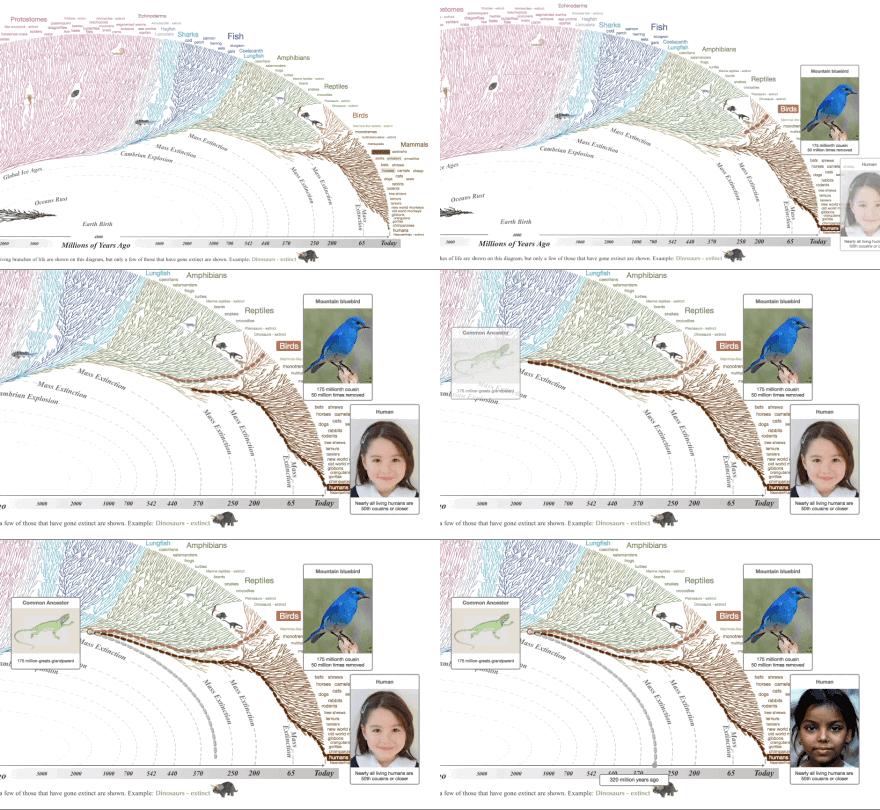
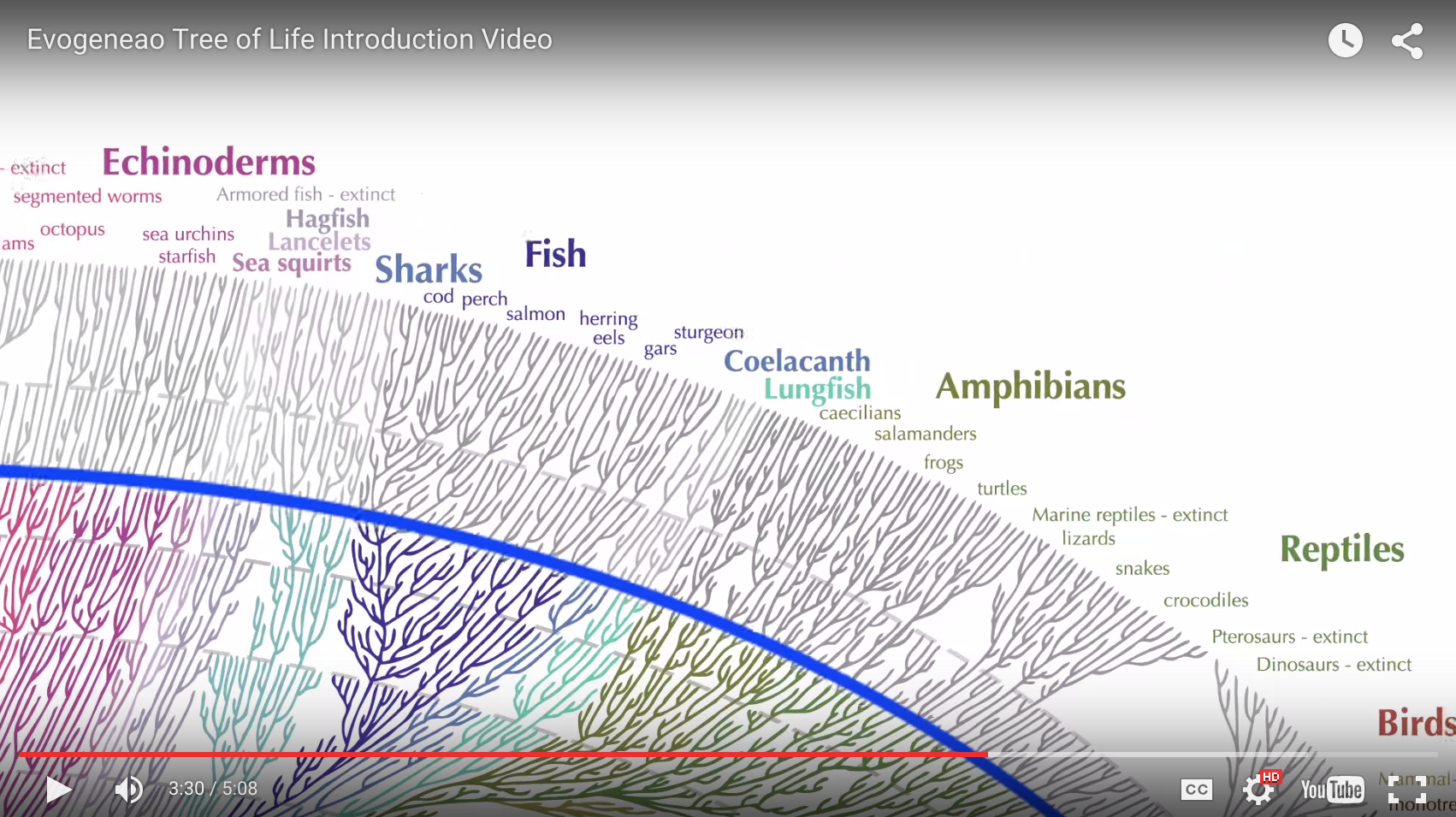
Biological evolution proposes that all living things, including humans, have a common ancestor with any other living thing. On the Great Tree of Life you can explore when in the distant past these common ancestors lived. For example, explore when the common ancestor between fish and humans lived by using the partial Great Tree of Life diagram above. Begin by tracing the human branch back through time. Start at the point on the outer margin of the tree (in other words, today) that is labeled 'humans'. Follow it back in time down the dark brown mammal branch to where it joins the light brown mammal-like reptile branch, then continue back along the green reptile branch, the olive-green amphibian branch, the aqua lungfish branch, and the light blue coelocanth branch to the point where you meet the bright blue fish branch. This point on the Great Tree of Life represents the common ancestor between humans and fish (in this case, salmon), and, by using the time scale, you can see that this creature lived roughly 440 million years ago. The time of a common ancestor between any two of life's branches, large or small, on the Great Tree of Life can be found in the same way.

Want to try another one? Follow the Reptile branch back in time to the point where it meets the Amphibian branch. Compare this to the curved time lines and you can see that this meeting point, which represents the time when the common ancestor between amphibians and reptiles lived, was about 340 million years ago. Each of the major branches on the Great Tree of Life are color coded to make them easier to distinguish from neighboring branches.

Our Understanding Will Evolve

As our understanding of life's history improves (by further discoveries in the fossil record and genetics), some of the branching relationships and times of common ancestors depicted on this tree of life will inevitably become outdated.


Ashland, Oregon | Copyright 2008. Leonard Eisenberg. | All rights reserved.